GLP-1 vs bariatric surgery — which is right for you?
By the ZIVOLABS Medical Team · Updated April 2026 · 9 min read
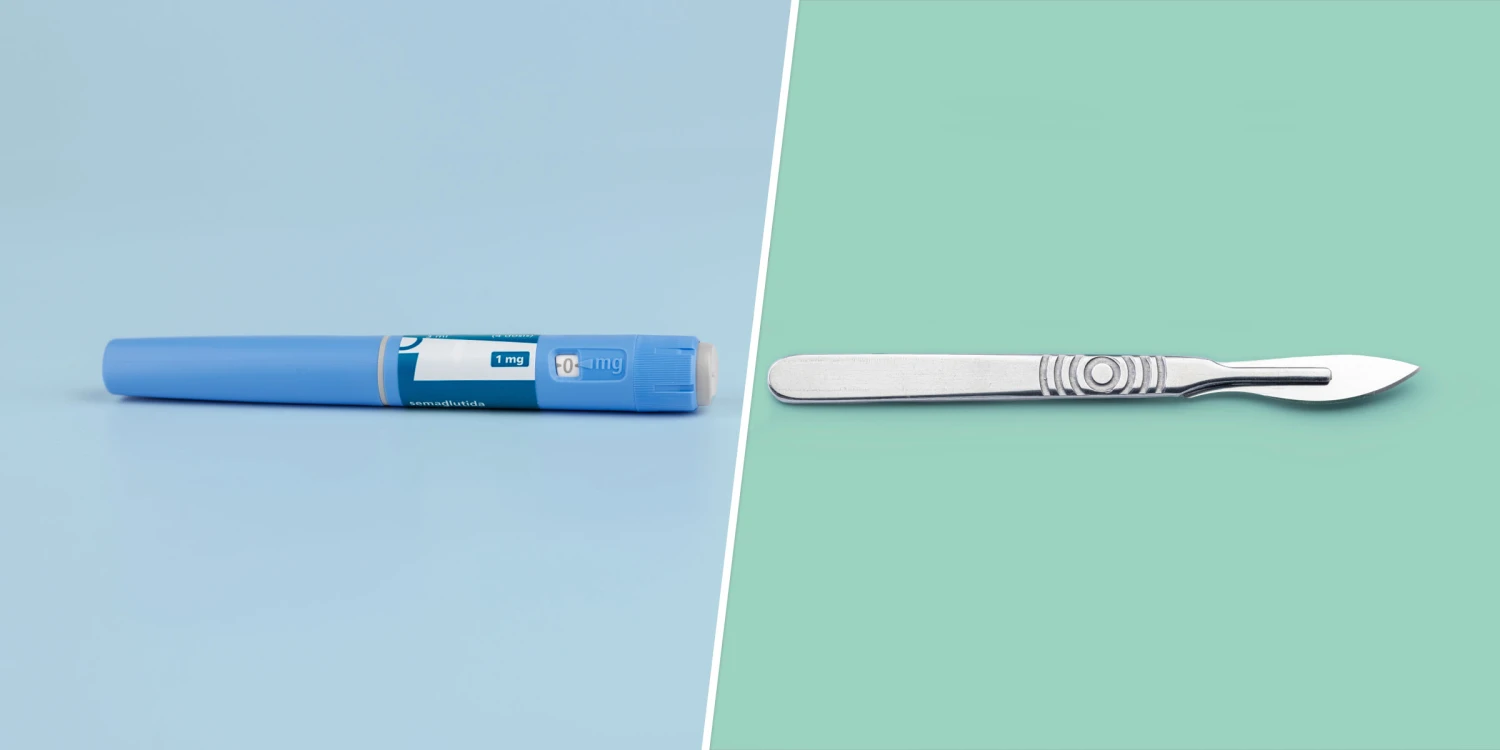
If you have been struggling with significant weight for years, you have probably heard about two serious medical options: bariatric surgery and GLP-1 medications like semaglutide. Both work. Both are legitimate. But they are not the same decision — and choosing the wrong one for your situation can mean unnecessary risk, unnecessary cost, or unnecessary delay in getting results.
This article gives you an honest, doctor-reviewed comparison so you can have an informed conversation with your physician.
What is bariatric surgery?
Bariatric surgery is a category of surgical procedures that physically alter your digestive system to limit how much food you can eat and absorb. The most common types performed in India are:
Sleeve gastrectomy: Removes roughly 80% of the stomach, leaving a narrow tube. You feel full faster and eat much less.
Roux-en-Y gastric bypass: Bypasses a portion of the small intestine in addition to reducing stomach size. More complex, with stronger metabolic effects.
Mini gastric bypass: A simpler variation of gastric bypass, increasingly common in Indian centres.
Bariatric surgery has been available in India for over two decades. It produces dramatic, lasting weight loss — typically 25–35% of total body weight — and can put Type 2 diabetes into remission in many patients.
What is GLP-1 medication (semaglutide)?
GLP-1 receptor agonists like semaglutide work by mimicking a hormone your gut naturally produces after eating. This hormone signals to your brain that you are full, slows the emptying of your stomach, and reduces appetite at a biological level — not through willpower.
Semaglutide (sold as Ozempic, or in India as Semasize and Semanat) is taken as a once-weekly injection. Clinical trials showed average weight loss of 10–15% of body weight over 12–16 months, with continued loss possible beyond that. It also meaningfully improves blood sugar, blood pressure, and cardiovascular risk markers.
It is not a diet pill. It does not suppress you artificially. It changes how your body responds to food.
Side by side: the honest comparison
Factor | GLP-1 (semaglutide) | Bariatric surgery |
|---|---|---|
Average weight loss | 10–15% body weight | 25–35% body weight |
How quickly results begin | 4–8 weeks | 2–4 weeks post-surgery |
Reversible? | Yes — stop the medication | No — permanent anatomical change |
Requires hospitalisation? | No | Yes (2–5 days) |
Recovery time | None | 2–6 weeks |
Upfront cost (India) | ₹4,999/month | ₹3–5 lakh (one time) |
Cost over 12 months | ~₹60,000 | ₹3–5 lakh |
Suitable for BMI 27.5–35? | Yes | Usually not recommended |
Suitable for BMI 35+? | Yes | Yes |
Requires anaesthesia? | No | Yes (general anaesthesia) |
Risk of surgical complications? | None | Exists (bleeding, leaks, clots) |
Works for diabetes? | Yes — significant improvement | Yes — can induce remission |
Long-term maintenance needed? | Ongoing medication | Dietary compliance lifelong |
When surgery makes sense
Bariatric surgery is a powerful tool — and for the right patient, it can be genuinely life-changing. It tends to be the better option when:
You have a BMI above 40, or above 35 with serious obesity-related conditions like uncontrolled Type 2 diabetes, severe sleep apnoea, or joint disease that significantly impacts mobility. At this level, the magnitude of weight loss that surgery produces can be difficult to achieve through medication alone in a reasonable timeframe.
You have tried structured medical approaches and they have not worked. Surgery is often considered after supervised attempts at medical weight loss have been insufficient. GLP-1 medication is now part of that medical pathway — and for many patients, it succeeds where diet programs alone failed.
You want a one-time intervention rather than ongoing medication. Some patients prefer a permanent solution over a monthly commitment. Surgery delivers rapid, large-scale results that do not require daily discipline in the same way — though it does require permanent dietary adjustments.
Your health insurer covers bariatric procedures. Some group health policies in India cover bariatric surgery when medically indicated. If yours does, the cost equation changes significantly.
When GLP-1 medication makes more sense
For a large and growing number of patients, semaglutide is the better starting point — or the right long-term solution. It tends to be the better option when:
Your BMI is between 27.5 and 37. Surgery is rarely recommended below BMI 35 in standard protocols. GLP-1 medication is approved and effective across a much wider BMI range, including the large population of Indians who are metabolically overweight without being in the severe obesity category.
You cannot or do not want to undergo surgery. Anaesthesia carries risk for patients with cardiovascular conditions, uncontrolled diabetes, or respiratory issues. GLP-1 medication requires no procedure whatsoever.
You want to avoid an irreversible intervention. Surgery permanently alters your digestive anatomy. GLP-1 medication stops working when you stop taking it — which is also what makes it safer and more flexible.
You have PCOS, hormonal weight gain, or metabolic syndrome. GLP-1 medications have shown particular effectiveness in these populations, where the weight gain is driven by hormonal and insulin resistance factors rather than purely behavioural ones.
Cost is a meaningful factor. At ₹4,999 per month through ZIVOLABS, a full year of semaglutide costs approximately ₹60,000. Surgery costs ₹3–5 lakh before accounting for any complications, follow-up procedures, or nutritional supplementation. For most Indian families, this is not a small difference.
Can you do both?
Yes — and increasingly, doctors are using GLP-1 medication as a bridge to surgery, or as a long-term solution after surgery to prevent weight regain.
Some patients start on semaglutide, lose 10–12% of their body weight, and then find that surgery is no longer necessary — or that they now qualify for surgery at lower risk because their metabolic markers have improved. Others use GLP-1 medication post-surgery to maintain results when weight creep begins.
These are not competing options. They are tools in the same medical toolkit.
What Indian doctors actually recommend
The guidance from Indian metabolic specialists has shifted meaningfully in the past two years. The general framework now looks like this:
BMI 27.5–32 with comorbidities → GLP-1 medication as first-line treatment
BMI 32–37.5 → GLP-1 medication first; surgery considered if inadequate response after 6–12 months
BMI 37.5–40 → Either option; shared decision-making with patient
BMI 40+ → Surgery is strongly considered; GLP-1 may be used to reduce surgical risk first
This is a general framework, not a prescription. Your doctor will assess your full history, bloodwork, comorbidities, and personal preferences before making a recommendation.
The question most people do not ask
Most patients ask "which one works better?" The more useful question is: which one is appropriate for me right now, given my BMI, health status, risk tolerance, and financial situation?
For a 38-year-old woman with a BMI of 31, PCOS, and no desire to undergo surgery — semaglutide is clearly the right starting point.
For a 45-year-old man with a BMI of 44, Type 2 diabetes, and a health policy that covers bariatric procedures — surgery may be the more appropriate intervention.
Most people reading this article fall into the first category. The population of Indians who are overweight or metabolically obese but below the surgical threshold is enormous — and until recently, they had no effective medical option. GLP-1 medication changes that.
Frequently asked questions
Is bariatric surgery permanent? Yes. Bariatric surgery permanently alters the size and in some cases the arrangement of your digestive system. This cannot be reversed. Some patients experience complications years later that require further procedures. This permanence is why doctors recommend exhausting medical options — including GLP-1 medication — before proceeding to surgery for most patients.
Does semaglutide work as well as surgery? It produces less total weight loss — 10–15% versus 25–35% — but for patients who do not need or qualify for surgery, it produces clinically meaningful results that significantly improve metabolic health, quality of life, and long-term disease risk.
What happens if I stop semaglutide? Most patients regain some weight after stopping semaglutide if no other lifestyle changes have been made. This is why ZIVOLABS programs include dietary guidance alongside medication — to help patients build habits that support long-term results. This is also true, to a lesser extent, of bariatric surgery — patients who do not adjust their diet after surgery can regain weight over time.
How do I know which one my doctor will recommend? Your doctor will consider your BMI, existing health conditions, previous weight loss attempts, surgical risk, and personal preferences. A ZIVOLABS consultation is a good starting point — our doctors can give you a clear picture of whether you are a candidate for GLP-1 medication and whether surgery is worth exploring further.
Ready to explore your options?
A ZIVOLABS doctor can assess your profile and give you a clear, personalised recommendation — including whether GLP-1 medication is right for you or whether a surgical referral makes more sense. There is no pressure and no obligation.
[Start your free health assessment →]
This article is for informational purposes only and does not constitute medical advice. Bariatric surgery and semaglutide are both prescription-level medical interventions that require evaluation by a qualified doctor. Individual results vary. Always consult your physician before making any treatment decision.

Join India's weight loss revolution
See a specialist online. Get prescribed. Receive at your door.
Not a diet. Not a gym plan.
Medical science. Finally in India.
Available in both Weekly Injection & Daily Tablets
Lose 15-17% of body weight — clinically proven*
Unlimited 24/7 support included
No hidden fees! Everything you need is included
Start for just Rs. 4999 + free delivery
Takes 5 minutes. No commitment required.